🫧 Bubbly Science
Bubble Science made simple, fun, and easy to understand for KS1 & KS2
Welcome to Bubbly Science—where science becomes fun, visual, and easy to understand.
We take bubble science and break it down into simple ideas that KS1 and KS2 learners can actually understand and enjoy. No confusing language. No complicated theory. Just clear, exciting science that makes learning stick.
- Free Bubbly Science Teachers Resource PDF (Click to view and download)
- Free Bubbly Science Reflection Sheet for Teachers & Learners (Click to view and download)
- Why are bubbles good for us?
Breathing: When you blow bubbles, you breathe out slowly and carefully. This can help you feel calm, happy, and in control of your feelings.
Feel-Good: Playing with bubbles is so much fun that it helps your brain make a special “feel-good” chemical called dopamine, which makes you feel happy and relaxed!
- What are bubbles made of?
Soap and water. BOOM!
WATER is the bubble super star! It has two superpowers; It is sticky! It sticks to itself (scientists call this cohesion) and it sticks to other things (scientists call this adhesion). Those scientists have a fancy word for everything!
SOAP is water’s best friend. Soap makes water relax, catch air and form bubbles —POP!—bubbles everywhere!
- When making bubbles BLOW, don’t suck!
The soap makes it unsafe for people, animals and plants!
“Bubble rule number one: Blow slow and watch it go!”
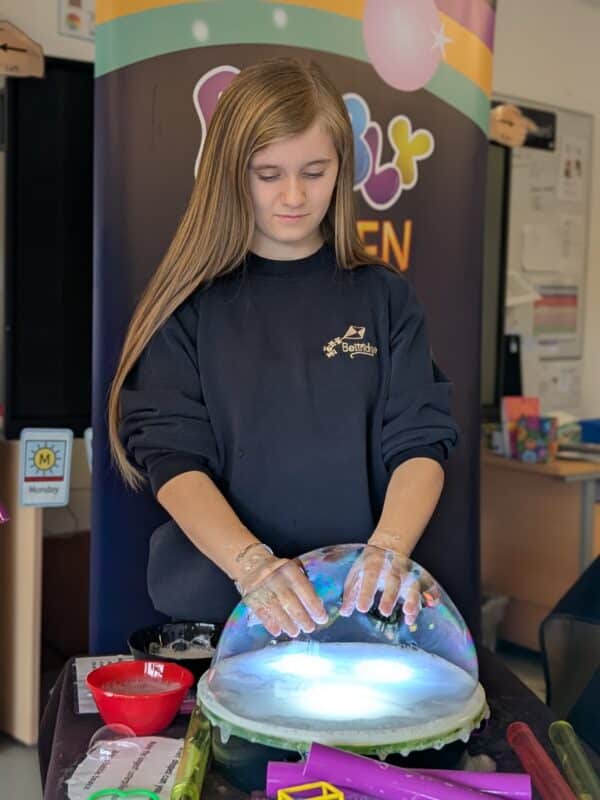
- The Jumbo Bubble
Blowing Bubbles with Science! Want to blow bubbles like a scientist? Here’s the secret: wind control!
- For small bubbles: Hold the wand close to your mouth and blow gently. You’re making wind with your breath! (Do it—put your hand in front of your mouth and feel the breeze!)
- For BIG bubbles: Move the wand further away and blow! The air pulls more air in and fills the bubble quickly, thanks to the Bernoulli Principle. This is the same science that makes airplanes fly—how cool is that?
- What shape are the bubbles?
Bubbles make round shapes called spheres!
Imagine Air Pressure as a friend, gently pushing out the bubble from the inside. At the same time, water wants the bubble to be smaller and gives a big hug squeezing in from the outside. Together, they work as a team to make a nice, round bubble!
- How are bubbles made?
When you make a bubble by blowing or waving a wand, it’s all about air pressure! Use your own human pump (your lungs). Blow on your hand—feel the breeze? That’s the air pressure that fills the bubble!
To make a bubble, you need the Perfect Puff:
- Blow too hard? POP! The Death Puff blows the bubble into smithereens
- Blow too soft? No Puff nothing happens.
- Blow just right? Ta-da! You blew the Perfect Puff and a bubble appears!
- What’s inside a bubble?
When you make a bubble, the gas inside is air! If you blow it with your breath, the air has more carbon dioxide and less oxygen because it’s the air you just breathed out!
- What pops a bubble?
The Death Puff blows the bubble into smithereens—too much pressure! It blows out like a candle flame.
The Finger of Doom – Is it because it’s sharp? NOPE! It’s dryness— DRY floors, plants, insects, dust and more, ALL make bubbles pop.
Slow Death – The water slowly evaporates until the bubble is too thin to exist.
“Death puff and all things dry – Are what make the bubbles die.”
- Why do bubbles stick together?
It’s not soap, it’s not magic—it’s water! Water is sticky! That’s why your swimsuit sticks to you or your hair clumps together when it’s wet. Water is our superstar!
Bubbles stick together because of water too. That’s how we can hold bubbles and make all kinds of fun shapes!
“Sticky water saves the day – Catching bubbles as you play.”
- The Water Sandwich
Superstar Water and its bestie, Soap, love to groove!
First, in the bowl, they’re just chilling, mixing, dancing the Brownian Motion and doing their homework. THEN, we dip the wand—plop! As we pull the wand out, in an instant forces make a water sandwich.
Here’s how it works:
- The superstar Water becomes a thin squishy filling in the middle, giving the bubble its superpowers.
- Soap forms two thin protective layers on the outside, like the bread, holding the water inside and keeping it safe and balanced.
- How thin is a bubble?
A bubble film is the thinnest thing you can see with the naked eye! It’s thinner than dragonfly wings or a spider’s web. The colours in the bubble show how thick it is.
As the bubble gets thinner, the colours change and slowly disappear, leaving a ghost bubble—a soft, almost invisible sphere. “Whatcha gonna see? GHOSTBUBBLE!”
- Why are bubbles colourful?
Bubbles look colourful because light reflects off them in a special way. Bubble colours are iridescent due to the interference between reflected light.
- What colours are in a bubble?
The colours from a bubble are iridescent colours (reflection), not rainbows (refraction). You can also see these special colours in nature, like on peacocks and beatles. The colours tell us how thick the bubble is: “Whatcha gonna see? GHOSTBUBBLE!”
|
Green: Thick and brand new! |
Blue: A little thinner |
Pink: Getting thinner |
Purple: Even thinner |
Yellow: Super thin, the bubble’s almost gone! |
Clear, very, very thin, almost invisible ready to pop! |
The colours from a bubble are
- Why do we see images in bubbles?
It’s all about reflection! Bubbles act like tiny mirrors, just like shiny spoons or funhouse mirrors. When light hits the curved surface, it bounces back, showing us the world in a fun, wobbly way—even upside down!
- Bubble Foam – Switch all the colours on!
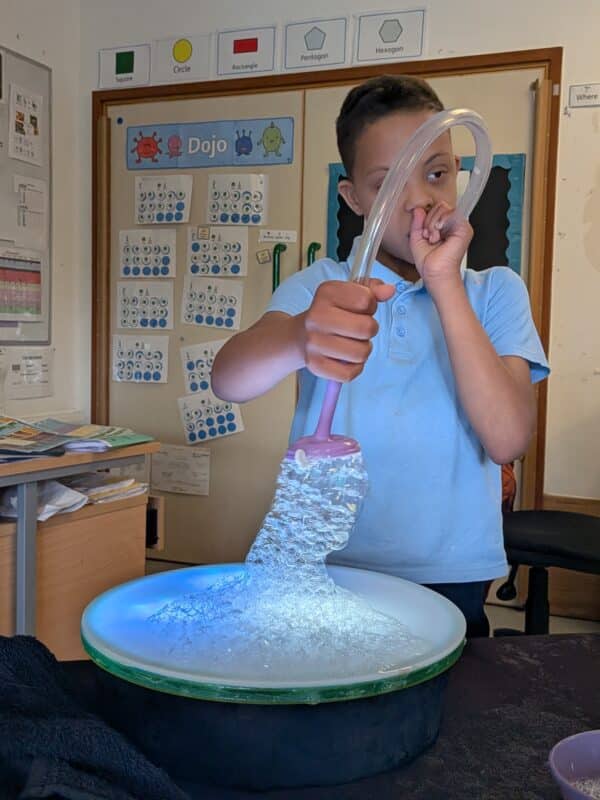
What happens if we have THOUSANDS of colourful bubbles? We get white foam! Wait, what? But where do all the colours go?
They’re still there! Let’s explain this puzzle!
Each bubble still reflects colour, but with so many bubbles facing every direction at once, your eyes see all the colours at the same time—making it look white!
It’s the opposite to Painting:
- When you paint and mix all the colours together, you get… BLACK (or brown if a few colours are missing).
- With paint, white happens when there are no colours.
It’s the same as Screens:
- Think about your screen, the screen is black where the light is off, and white when all the colours are switched on.
- With light, white happens when all the colours are present!
- How to make a giant bubble?
Science to the Rescue! To make giant bubbles, we need a special helper called a polymer. Polymers make the bubble mix stretchy so the bubbles can grow super big without popping.
We use a plant polymer called Stretchy the Bubble Builder! It is “plant snot” and helps us make amazing giant bubbles!
- How are bubbles used in real life?
You can become a bubble artist like me and play with bubbles your whole life or a bubble scientist and play with bubbles your whole life. Bubbles are used in space, climate change, medicine and much more.
Free Bubble Recipes: https://www.bubblyheaven.co.uk/how-to-make-bubble-fluid/
Learn how to deliver and fun and engaging bubble workshop: https://www.bubblyheaven.co.uk/product/indoor-bubble-workshop-course/
Book us to deliver a fun and engaging bubble science workshop: https://www.bubblyheaven.co.uk/bubble-science-workshop-gloucestershire/
Bubble Wands: www.bubblyheaven.co.uk/shop
Thomas C. Altman’s, Bubble Science Book: https://amzn.to/4af9osn
Bubble Science Links: https://www.bubblyheaven.co.uk/bubble-science-links/
Book Maths Shows & Workshops: www.bubblymaths.co.uk Book Bubble Parties & Science Events: www.bubblyheaven.co.uk