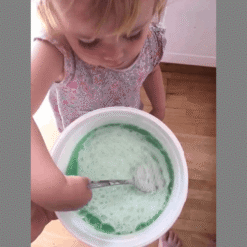
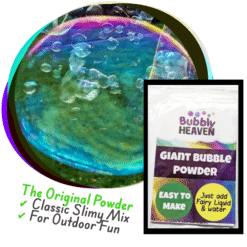
I have a big weekend of blowing bubbles and I’m dealing with some lumpy solution! I just made a smaller batch where I tripled your recipe and everything was good. Now I’m making double that…
A message from a customer, May 2025 — one of five people who have asked me the same thing
This email always arrives at the same moment: the night before a big weekend, with a bucket of lumpy bubble mix and a show in the morning. So let’s deal with the panic first, and the chemistry second.
The short answer: don’t throw it away, and don’t whisk it. Nine times out of ten a lumpy batch fixes itself if you give it warmth and time, and most of the damage I see is done by people trying to fix it in a hurry.
What the lumps actually are
They are almost never soap. They are dry polymer — the thickener in your powder or recipe — that never got wet in the middle.
When polymer powder hits water it starts swelling on contact. If a clump of it lands in the bucket all at once, the outside swells into a gel skin within seconds, and that skin seals the dry powder inside away from the water. You end up with what looks like frogspawn: jelly beads floating in thin liquid. The liquid is thin precisely because the thickener is trapped inside the lumps instead of spread through the mix.
That is why a lumpy batch usually makes disappointing bubbles as well as looking unpleasant. It isn’t ruined — it’s just unfinished.
Why it happens when you scale up
This is the bit nobody warns you about, and it’s why the lumps appear on the big batch rather than the small one you practised with. Doubling a recipe doesn’t double the difficulty — it more than doubles it, for four reasons:
- You tip instead of sprinkle. A teaspoon gets sprinkled. Half a tub gets tipped. Tipping is what creates clumps.
- The stirring doesn’t scale. The same spoon and the same thirty seconds moves a lot less water in a 20-litre drum than in a jug.
- Big containers have dead corners. Powder settles where your spoon never reaches, especially in a rectangular trug.
- The water is colder. A jug of warm water stays warm. Twenty litres from the tap is barely lukewarm by the time you have finished pouring.
A word on how much thickener you actually need
There is a reassuring line on the Soap Bubble Wiki’s ingredients page: the precise role polymers play is, in their words, “a bit of a mystery”. Effectiveness is not simply about how thick the mix is. So if you have been assuming that thicker means better, and adding extra powder to compensate, that is worth un-learning — it is one of the most common causes of a lumpy batch.
Their guar gum page puts the useful working range at roughly 0.5 to 3 grams of guar per litre of water. Above that you are not making better bubbles, you are making lumps.

How to rescue it — in this order
- Leave it alone somewhere warm for 12 to 24 hours. This is the single most effective step and it costs nothing. Most lumps are only half-hydrated, and time finishes the job. Put the container somewhere genuinely warm — an airing cupboard, next to a radiator, indoors overnight rather than in the car or the shed. Lid on, don’t stir.
- Sieve it. Next morning, pour it through a fine kitchen sieve, a square of muslin, or a piece of old net curtain into a clean container. Whatever is left in the sieve was never going to dissolve. Don’t push it through with a spoon — you will just shred the lumps into smaller lumps.
- Only then, whisk — gently, and only if you must. A slow stir with a whisk near the bottom of the container can break up the last of it. But be clear about the trade: whisking makes foam, and foam is worse for your bubbles than lumps are. Foamy mix gives you dull, heavy, short-lived bubbles. And if you do whisk, you have just committed to another overnight rest for the foam to settle — so you have gained nothing over step one.
- Skim the foam. Lift it off with a spoon or a sieve rather than stirring it back in. There is more in my guide to stopping foamy mixture.
If the show is tomorrow morning: do step one with the lumpy batch, and at the same time make a small fresh batch you know will work. Then you have a guaranteed bucket for the morning and a probably-fine bucket as backup. Never travel to a paid booking with only rescued mix.
When it isn’t lumps, and isn’t worth saving
Sieving and resting will fix hydration problems. They will not fix these:
- It smells sour or yeasty. That is microbial growth, usually in a batch that has been sitting for weeks in warmth. Pour it away.
- It is gritty rather than jellyish. Grit is sand, soil or crushed leaf from a previous outdoor session. Sieving helps, but check the container is actually clean — anything like fabric conditioner left in a bucket will kill bubbles outright.
- It has gone watery and stays watery after resting. If the polymer has passed its best — guar gum in particular loses its power with age — no amount of resting brings it back. Start again with fresh powder. J-Lube, being synthetic, keeps far longer.
How to never have this problem again
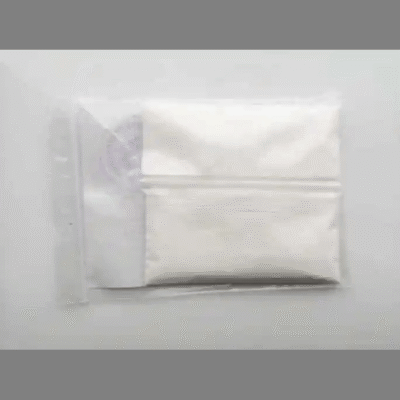
- Wet the powder before it meets the bucket. This is the habit that removes most lumps forever. For a DIY guar recipe, the trick is to slurry the powder first in something it will not dissolve in — glycerine, or very cold water — then stir that slurry into your warm water. The grains separate before they ever get the chance to gel together.
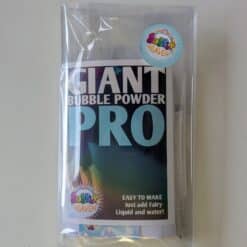
- If you are using a ready-made powder, follow the tub. Blended powders are designed to go in a particular way, so check the instructions rather than assuming the guar trick applies.
- Sprinkle from height, into moving water. Stir with one hand, sprinkle slowly with the other. Never tip.
- Use warm water for the main batch. Hand-hot, not boiling.
- Add the washing-up liquid last, and stir gently. Soap in early means you are whisking foam for the whole mixing process. And use the right soap — Fairy Platinum or Fairy Max Power in the UK, Dawn Platinum elsewhere. Check the bottle each time, because formulations change.
- Mix 24 hours ahead as standard. Not as a rescue, as your normal routine. Mix on Friday for a Sunday event.
- Scale up in batches, not in one giant go. If you know a 5-litre batch works perfectly, make four 5-litre batches and combine them. Ten extra minutes, and it never fails.
Still not right?
If the mix is smooth and it is still not performing, the problem is somewhere else — usually the soap, the temperature or the water. Work through my full troubleshooting guide, or send me a short video of your process to cheryl@bubblyheaven.co.uk and I will take a look, even if you are not using my products.
Huge tip for performers and party people
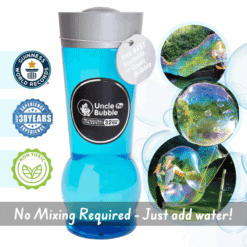
When you are being paid to turn up, always keep a bottle of Uncle Bubble concentrate in the cupboard and in your kit box.
Concentrate is the thing that saves a job. It keeps for ages, it takes up almost no room, and it is ready the moment you need it — just add water. No polymer to hydrate, no 24 hours to wait, no lumps to sieve. If your batch has gone wrong and the show is in an hour, that bottle is the difference between doing the show and making an apology.
Mine lives in the kit box permanently and I don’t touch it. It is not the mix I plan to use. It is the mix I am glad I have got.
Sources and further reading
Shop Bubble Mix & Powder